Theoretical Nanoelectronics
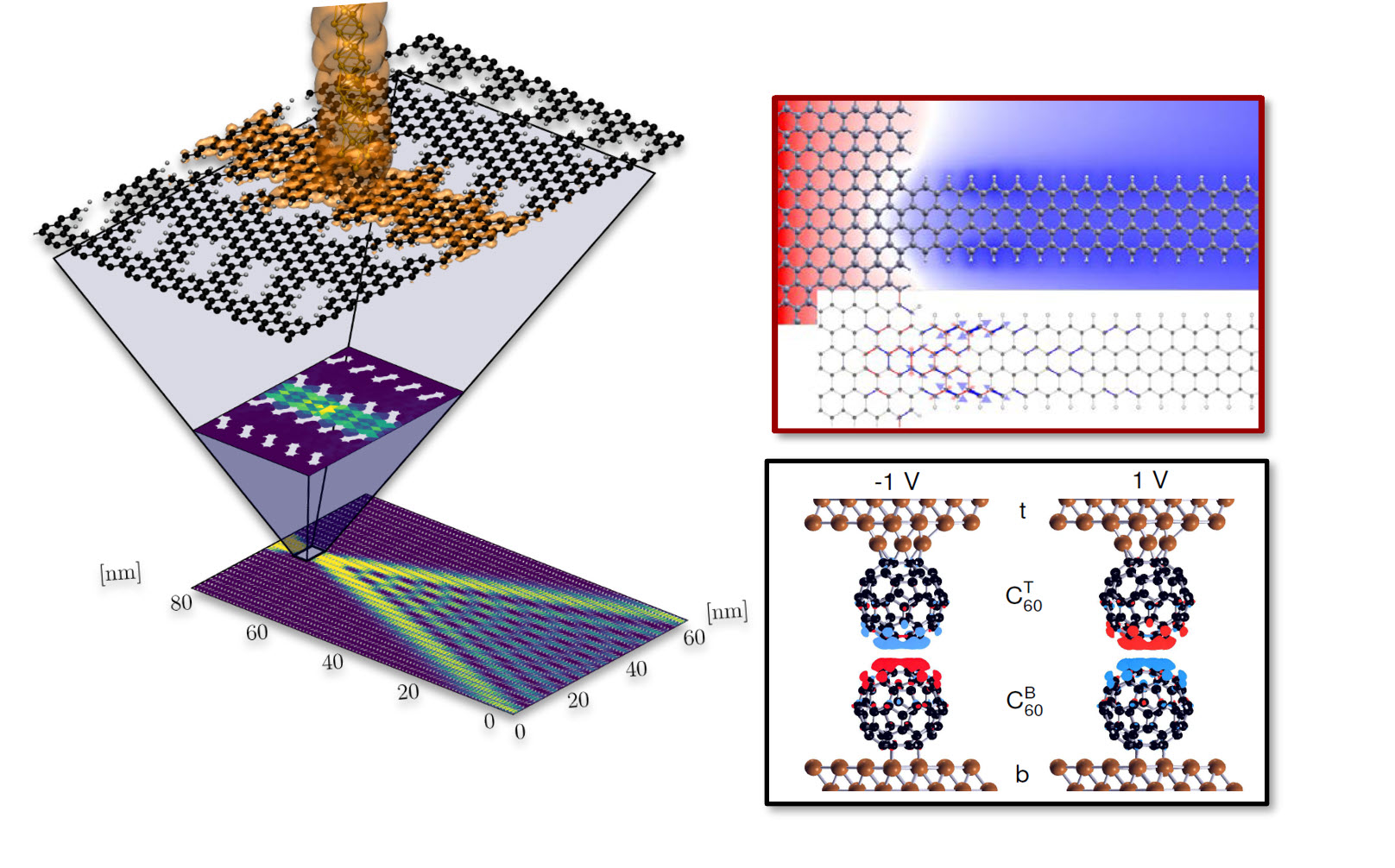
The Theoretical Nanoelectronics group is focused on theory and computer simulation of transport properties of nano-scale devices “under working conditions” – i.e. out of equilibrium. Our calculations address electron and heat transport, electron-phonon interaction, and current-induced atomistic processes.
We develop and use computational methods and software, mainly based on non-equilibrium Greens functions and density functional theory (DFT-NEGF). With these methods it is possible to calculate properties with no or few fitting-parameters. We have especially focused on systems based on graphene and other two-dimensional materials, molecular nano-structures, nano-junctions, and nanowires.
Keywords:
- Nanosystems theory/simulation
We develop advanced computational models to study nanoscale systems at the atomic and electronic level. By combining first-principles methods, atomistic simulations, and multiscale modeling, we aim to understand fundamental behaviors in low-dimensional materials and devices, enabling predictive design of next-generation nanosystems. - Quantum transport
Our research focuses on quantum transport phenomena in nanoscale and 2D systems. We investigate how electrons, spins, and energy move through materials under different conditions, uncovering novel behaviors that can inform the design of high-performance quantum and nanoelectronic devices. - Nanoelectronics
We explore the physics and engineering of nanoscale electronic devices, studying their performance limits and developing innovative architectures. Our work leverages quantum effects and low-dimensional materials to create faster, more efficient, and functional nanoscale circuits and devices. - 2D materials
Our primary focus is on 2D materials, such as graphene, transition metal dichalcogenides, and novel layered systems. We study their structural, electronic, and transport properties, and integrate them into devices for applications in nanoelectronics, quantum technologies, and energy conversion. - Molecular electronics
We investigate charge and energy transport through single molecules and molecular assemblies. By understanding the underlying mechanisms, we aim to design functional molecular-scale devices and exploit molecular systems for innovative electronic applications. - Machine Learning
We apply machine learning to accelerate simulations and materials discovery. This includes developing ML potentials and surrogate models that allow faster, more accurate simulations of complex nanosystems, enabling high-throughput exploration and predictive design of materials and devices.
Group Members
Name Title E-mail Building and room Professor mabr@dtu.dk 309251 Postdoc vicros@dtu.dk 309245 Postdoc snemi@dtu.dk 309250 PhD student alemor@dtu.dk 309245 Niels Gabriel M.Sc. student s214451@dtu.dk 309242
Contact
Mads Brandbyge Professor Phone: +45 45256328 mabr@dtu.dk