Energy technology

DTU researchers to build the world's first neutron microscope that can see inside batteries

Using the world's most powerful neutron source and technology from space telescopes, DTU researchers will create a unique microscope that can look inside batteries and see what happens when they break down. This could lead to better battery materials in the future.

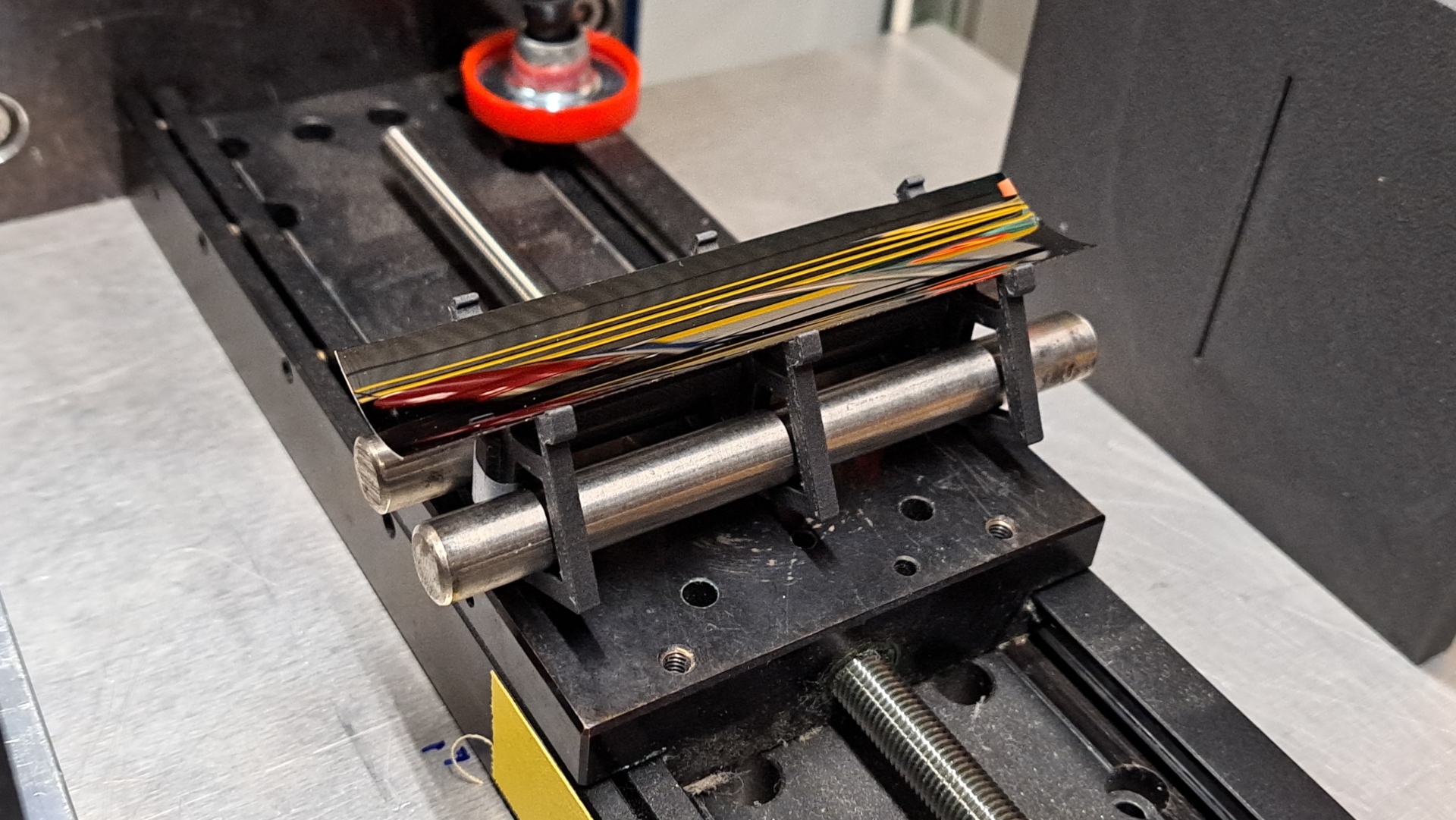
A mirror for the neutron microscope is only a few nanometres thick and extremely difficult to manufacture. The mirror is 10 cm long and has a radius of curvature of two cm. Photo: Luise Theil Kuhn

FaCTS

ESS is a joint European research infrastructure currently under construction outside Lund in Sweden.

Using a particle accelerator, ESS accelerates a beam of protons to 96% of the speed of light. The protons collide with a target of the heavy metal tungsten, which releases a large number of neutrons from the metal. This nuclear reaction is called spallation.

The neutrons knocked out of the tungsten target are slowed down to around the speed of sound and directed through tubes to a number of scientific instruments – for example, the neutron microscope that Luise Theil Kuhn and her colleagues are working on.

Data from the instruments is transferred to ESS’s Data Management & Scientific Computing centre, which is based at DTU in Lyngby. Here, the very large amounts of data can be processed and used for research.

Construction of ESS began in 2014, and the infrastructure is expected to be fully operational in 2028.

Research infrastructure worth billions

In Lund, Sweden, the world's most powerful neutron source, the European Spallation Source (ESS), is being built, hosted by Denmark and Sweden. It is in this research infrastructure, which is expected to cost around DKK 17 billion, that Luise Theil Kuhn and her colleagues will install their prototype. If the project is successful, their neutron microscope will concentrate the neutron beam from ESS, making it 100 times more powerful and thus able to see details down to at least 1/50 the width of a human hair.

This is partly due to a collaboration with CHEXS, a DTU spin-out that normally makes mirrors for X-ray telescopes for NASA and ESA, but which can be adapted for a neutron microscope.

"The mirrors must be of very high quality with curved, thin metal layers. At the same time, they must be very smooth and only a few nanometres thick, so they are incredibly difficult to manufacture – virtually only CHEXS and NASA can make them," says Luise Theil Kuhn.

Once the microscope is ready, it will be able to record 3D films of how materials change in real time. These could be lithium-ion batteries used in everything from mobile phones to electric cars, but also electrolysis cells for use in Power-to-X plants.

In the longer term, the neutron microscope will be installed at ESS and made available to researchers from all over the world.

“If we can see what is happening inside the materials while they are working, we will be able to develop better batteries and more efficient electrolysis cells in the future and ultimately accelerate the green transition,” says Luise Theil Kuhn.

Contact

Luise Theil Kuhn

Luise Theil Kuhn Deputy Head of Department, Head of Section, Professor Department of Energy Conversion and Storage Mobile: 5141 9371